Blog
Cost of Solid Wood vs Veneer Doors: A Comprehensive B2B Buyer’s Guide

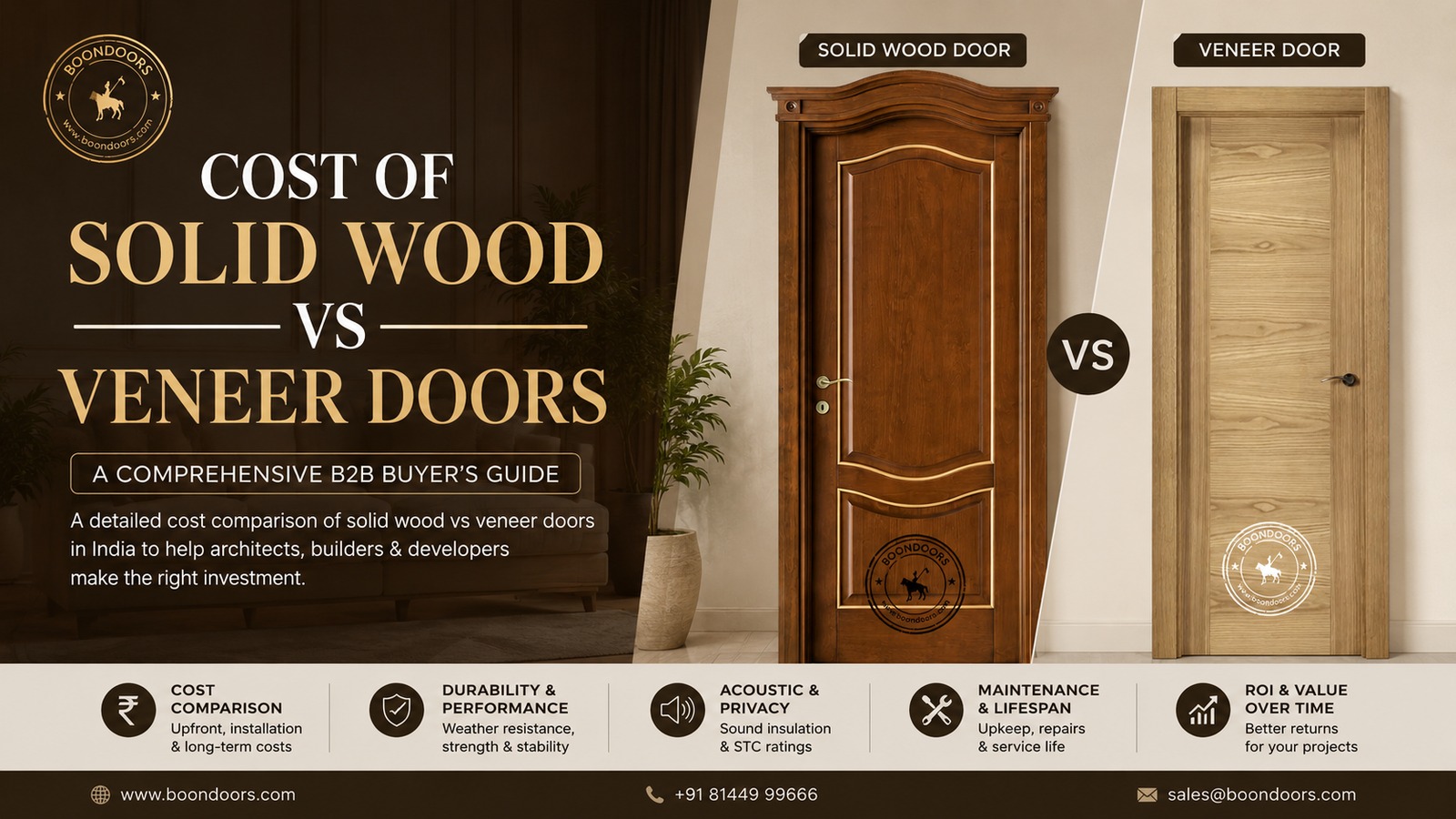
Are you an architect drafting specifications for an upcoming premium township, or a high-end property developer managing a luxury hotel project? When balancing material budgets against elite design standards, millwork procurement is often your most challenging line item. Choosing the wrong door type can lead to massive structural failures like warping or push your project costs way over budget.
The ultimate financial debate always comes down to a single question: What is the true lifecycle cost of solid wood vs veneer door installations in India? In summary, while raw solid wood is highly celebrated for its historic prestige, engineered veneer units provide incredible stability at a more accessible financial layout.
In this comprehensive 1600-word buyer’s guide, we will break down the upfront prices, installation expenses, and long-term maintenance costs of both options. Furthermore, we will show you how to maximize your return on investment (ROI) by partnering with an advanced, factory-direct manufacturer.
Upfront Investment: The Initial Price Breakdown
The initial purchase price is the first metric project managers look at when assessing the overall layout. In the Indian market, these two materials target completely different financial zones.
The True Cost of Premium Solid Wood Doors
Solid wood doors are manufactured using 100% natural timber throughout their entire frame and body. Because they require massive volumes of raw, slow-grown premium wood, their upfront cost is heavily tied to global commodity rates.
- Teak Wood (Sagwan): Genuine, seasoned Burma or high-grade African Teak doors typically range from ₹18,000 to ₹35,000+ per piece (roughly ₹500 to ₹1,000 per sq. ft.) for standard 7×3 feet sizes. For oversized grand entrances or custom hand-carved heritage pieces, prices can easily exceed ₹1,00,000 per unit.
- Sheesham and Hardwoods: Dense interior hardwoods like Rosewood or premium Sal wood hover between ₹9,000 and ₹18,000 per unit.
The Financial Advantage of Premium Veneer Doors
Veneer doors utilize an engineered solid core (such as dense pine blocks or stable particleboard) encased in a high-moisture resistant plywood frame, finished with a thin slice (usually 0.5mm to 4mm) of genuine decorative hardwood on the face.
Standard Interior Veneer Units: A high-quality solid-core veneer door using premium Oak, Walnut, or Teak skin costs between ₹5,500 and ₹12,000 per piece (roughly ₹250 to ₹550 per sq. ft.).
Main Entrance Decorative Veneer Units: Heavy-duty, Boiling Water Proof (BWP) marine-grade veneer slabs with thick designer skins run from ₹8,500 to ₹16,000 per piece.
The Initial B2B Takeaway: For a typical high-end residential project requiring 50 interior doors, opting for premium veneer over solid hardwood can save your project between ₹25,000 and ₹50,000 per opening in raw material costs alone.
Structural Performance and Environmental Costs
A door’s financial impact is not limited to the receipt from the factory floor. When analyzing the cost of solid wood vs veneer door installations, you must consider how each material behaves under local environmental pressures.
Weather Warping Factors in the Indian Climate
India faces extreme seasonal changes—from intense dry heatwave periods to heavy, saturated monsoons. Natural solid timber naturally expands and contracts as it breathes. If the wood is not meticulously seasoned, it will swell, stick, or crack, leading to expensive on-site structural repairs or premature replacement expenses.
Conversely, the engineered multi-layered cross-grain core within premium veneer doors completely neutralizes this directional movement. The face veneer remains perfectly flat, eliminating the risk of warping. This makes veneers an exceptionally cost-effective and low-risk choice for coastal projects in humid metros or high-altitude luxury resorts.
Acoustic Privacy and Weight Considerations
Weight directly influences structural hardware budgets. A solid wood door weighs between 35 and 50 kg, requiring heavy-duty, expensive ball-bearing brass hinges to prevent sagging. A high-density solid-core veneer door weights a manageable 25 to 35 kg, reducing the structural strain on your frames while still delivering a satisfying, high-end “thud” closing sound and a certified STC (Sound Transmission Class) rating of 35+.
Direct Cost Comparison: Solid Wood vs. Veneer Doors
To help your procurement team make a highly calculated data-driven decision, here is a breakdown of the total cost of ownership across a 10-year commercial lifecycle for standard 7×3 ft dimensions.
| Cost Component (Per Door Unit) | Solid Timber (Premium Teak) | Premium Engineered Veneer |
| Initial Purchase Price | ₹22,000 – ₹35,000 | ₹6,500 – ₹11,000 |
| Skilled Installation Labor | ₹3,500 (Heavier, requires fine hand-planing) | ₹1,800 (Pre-machined, plug-and-play alignment) |
| Heavy-Duty Hardware Set | ₹4,000 (Reinforced brass/steel hinges) | ₹2,200 (Standard premium hardware metrics) |
| Factory Finishing / Polishing | ₹4,500 (Deep absorption, complex grains) | ₹2,500 (Smooth flat face, uniform intake) |
| 10-Year Upkeep & Anti-Pest Treatment | ₹6,000 (Requires periodic resealing) | ₹1,500 (Factory sealed, minimal touch-ups) |
| Total Estimated 10-Year Cost | ₹40,000 – ₹54,000 | ₹14,500 – ₹21,000 |
Refinishing and Long-Term Value Creation
The primary reason architects choose solid wood despite its high upfront price tag is its infinite refinishing potential.
The Heirloom Factor of Solid Wood
A solid wood entrance can be sanded down, re-carved, and re-polished 5 to 8 times over its lifespan. If a door gets dented or deeply scratched by moving furniture, a master carpenter can easily repair it on-site invisibly. This gives solid timber an average functional lifespan of 30 to 50+ years, making it an incredible investment piece for primary residential entries or historic preservation properties.
The Lifecycle Limits of Veneers
Because a face veneer sheet is a thin slice of wood, it can only tolerate light hand-sanding and re-polishing 1 to 2 times before wearing through to the underlying plywood substrate. Deep surface scratches can be difficult to patch invisibly, meaning veneer doors typically carry a functional lifespan of 15 to 25 years. However, in fast-paced commercial spaces or rental real estate, this perfectly aligns with standard interior remodeling cycles.
(For detailed, authoritative specifications on timber grading and sustainable forestry yields in India, you can explore the technical papers published by the Forest Research Institute of India.)
Boon Doors: Maximizing Your Project’s Millwork ROI
When premier engineering firms and top-tier hospitality developers need to balance tight financial budgets with world-class structural requirements, they partner with Boon Doors. Operating from our state-of-the-art 50,000 sq. ft. manufacturing facility in Jodhpur, Rajasthan, we have established ourselves as the premier authority for both premium solid wood and high-performance veneer door systems.
We eliminate the traditional middleman markup, allowing you to secure elite architectural woodwork directly from our desert factory floor.
Our Engineering and Seasoning Framework
Industrial Desert Kiln-Drying: We leverage the dry, arid climate of Jodhpur to naturally stabilize timber before running it through computer-controlled drying kilns. This guarantees our doors reach an optimal 8-12% moisture level, locking down potential maintenance issues by preventing field warping.
Automated Factory Pre-Machining: Our facility utilizes high-precision digital routers to pre-carve slots for biometric handles, modern hinges, and RFID hotel locks. This factory automation lowers your on-site installation labor costs drastically.
Certified Security Core Options: We offer certified fire-rated and sound-dampening acoustic core structures wrapped in exotic global veneers (like American Walnut or European Ash), giving you a 5-star look at a smart B2B cost.
Heavy-Duty Padded Logistics: We crate our shipments in foam-lined, reinforced industrial wooden enclosures, ensuring your order arrives at your construction site in flawless, ready-to-mount condition.
Explore our massive industrial catalogs, including our high-performance veneered series and solid wood masterworks, on the Boon Doors website today.
Frequently Asked Questions (FAQs)
What is the primary difference in the cost of solid wood vs veneer door units? The main price difference lies in the volume of raw timber used. In summary, solid wood doors use 100% natural timber throughout their construction, making them a premium luxury choice. Veneer doors utilize a stable, engineered core faced with a thin slice of real premium wood, lowering raw material costs significantly while maintaining a high-end natural appearance.
Which option is more resistant to warping in high-humidity areas? Premium veneer doors offer superior resistance to climate warping. Their engineered, cross-grain inner cores neutralize the natural expansion and contraction forces of wood, making them highly stable in humid coastal climates compared to solid wood doors, which require regular resealing.
Can a high-quality veneer door be sanded and re-polished like solid wood? Veneer doors can be lightly hand-sanded and re-finished 1 to 2 times over their lifecycle. However, because the face layer is a thin slice of premium timber, they cannot undergo deep machine sanding or extensive structural re-carving like a solid wood door, which can be refinished indefinitely.
Are engineered veneer doors suitable for main entrances? Yes, provided they utilize a Boiling Water Proof (BWP) solid core and a heavy-duty marine-grade face veneer. While solid teak remains the top traditional choice for primary entrances, a well-engineered, factory-sealed veneer door from an elite manufacturer serves as an incredibly stable and secure main entryway.
How does Boon Doors help developers cut installation expenses? Boon Doors pre-machines and pre-routes all hardware slots, lock pockets, and hinge locations using precision digital factory machinery. This “plug-and-play” delivery allows your on-site team to mount the doors quickly and perfectly, reducing skilled labor hours and avoiding site dust.


 Single Main Doors
 Double Main Doors
 Glass Main Doors
 Bedroom Doors
 Bathroom Doors
 Teak Wood Doors
 Oak Wood Doors



 Custom Door Finishes