Blog
How Much Does a Custom Wooden Door Cost in India?

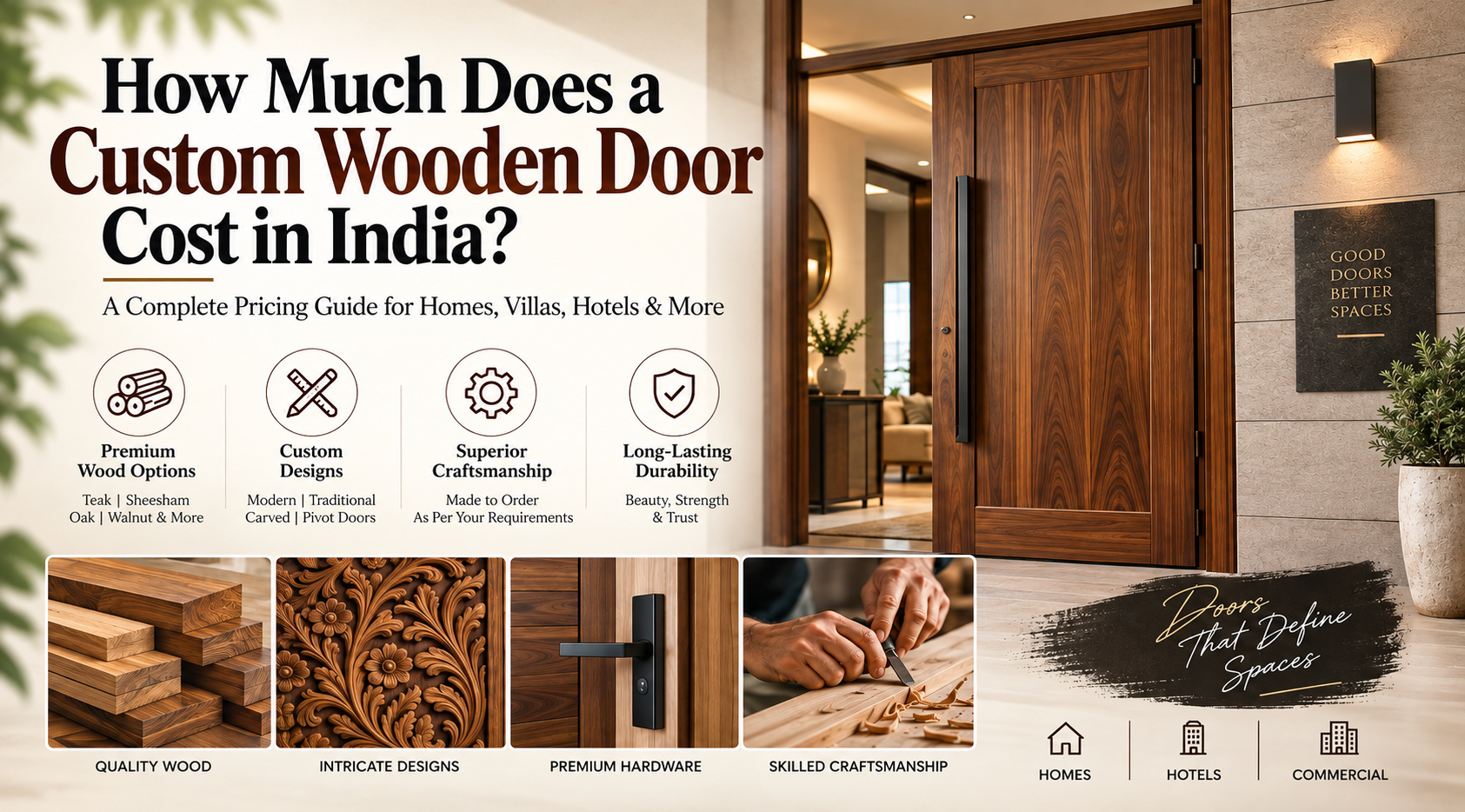
Custom Wooden Door Cost in India: Key Factors That Determine the Price
A custom wooden door can completely transform the entrance of a modern villa, luxury apartment, boutique hotel, or corporate office. As the architectural focal point of any property, the entrance door sets the stylistic tone for the entire interior while providing essential security, acoustic insulation, and durability.
However, prospective homeowners, builders, and interior designers frequently ask: how much does a custom wooden door cost in India?
The short answer is that custom timber door prices range anywhere from ₹5,500 for standard engineered interior doors to upwards of ₹1,00,000 to ₹2,50,000+ for oversized, hand-carved, or statement pivot doors. Because bespoke wooden doors are tailored to precise architectural drawings, the final quote depends on timber species, shutter thickness, door frame cross-sections, carving complexity, surface finishes, and architectural hardware.
This guide provides a comprehensive cost breakdown, rate per square foot (sq. ft.) estimates, material comparisons, and a checklist to help plan budgets and evaluate wooden door manufacturer quotes.
Custom Wooden Door Cost in India: Price at a Glance
Pricing for bespoke wooden doors is typically calculated either per finished shutter unit or on a rate per square foot (sq. ft.) basis. Below is an indicative market price estimate reflecting current Indian architectural and interior woodworking benchmarks:
| Door Construction & Type | Indicative Price Range (Per Shutter) | Average Rate (₹ / Sq. Ft.) | Typical Application |
| Standard Veneer / Engineered Flush Door | ₹5,500 – ₹16,000 | ₹350 – ₹650 | Bedrooms, bathrooms, study rooms |
| Solid Hardwood Door (Sheesham, Ash Wood, White Oak) | ₹12,000 – ₹35,000 | ₹750 – ₹1,200 | Premium interior doors, secondary exits |
| Solid Teak Wood Shutter (CP Teak / African Teak) | ₹18,000 – ₹45,000 | ₹1,100 – ₹1,800 | Main entrance doors, luxury apartments |
| Bespoke Burma Teak Shutter | ₹40,000 – ₹85,000+ | ₹2,200 – ₹3,800+ | High-end luxury villas, heritage properties |
| Intricately Carved Door / CNC 3D Reliefs / Metal Inlays | ₹50,000 – ₹1,20,000+ | ₹1,800 – ₹3,500+ | Pooja room doors, grand entryways |
| Oversized Architectural Pivot Door (7×4 ft to 9×5 ft) | ₹1,00,000 – ₹2,50,000+ | Bespoke project pricing | Statement villa entrance, resort lobbies |
Key Factors That Determine Custom Wooden Door Prices
Two doors built to identical dimensions can vary substantially in price. Understanding the primary cost drivers enables informed trade-offs between aesthetics, longevity, and overall budget:
1. Wood Species and Timber Grade
The choice of timber represents the single largest variable in door manufacturing. Natural timber varies widely in density, grain pattern, natural oil content, and resistance to weather and termites:
- Teak Wood (Sagwan): The gold standard for main entrance doors in India. Due to its natural silica and oil content, teak resists rot, warping, and moisture fluctuations. African Teak and CP Teak are popular mid-to-high choices (₹1,200–₹1,800/sq. ft.), whereas genuine, well-aged Burma Teak commands top-tier luxury pricing (often exceeding ₹3,000/sq. ft.).
- Sheesham (Indian Rosewood): A durable, heavy hardwood with expressive, contrasting grain lines. It is widely manufactured in traditional woodworking centers like Jodhpur and Saharanpur, offering excellent strength at a moderate price (₹800–₹1,300/sq. ft.).
- White Oak and Ash Wood: Highly favored in Scandinavian and contemporary interior design for their light tone, prominent open grains, and consistent finishing qualities.
- Walnut and Mahogany: Dark, sophisticated hardwoods prized for high-end luxury interiors and executive office suites.
- Engineered Pinewood: Commonly utilized as an internal core for veneer flush doors, delivering structural dimensional stability at an accessible cost.
2. Shutter Dimensions and Core Thickness
Standard Indian interior residential doors measure approximately 7 ft × 3 ft (21 sq. ft.) with a thickness of 32 mm to 35 mm.
- Entrance Doors: Main entrances typically require a minimum thickness of 38 mm to 45 mm to accommodate heavy multi-point locking systems and provide acoustic dampening.
- Oversized Doors & Grand Entrances: High-ceiling luxury homes increasingly incorporate doors measuring 8 ft × 4 ft, 9 ft × 5 ft, or full-height 10-foot double-shutter configurations. Doubling the surface area and increasing thickness to 50 mm or 60 mm significantly increases the volume of seasoned timber required, which scales raw material costs non-linearly.
3. Architectural Design, Carvings, and Decorative Inlays
The labor and machining required to execute an architectural concept impact production costs significantly:
- Minimalist Flush / Grooved Profiles: Contemporary designs featuring clean V-grooves, reeded surfaces, or fluted panels machined via CNC routers remain cost-effective because of reduced production hours.
- CNC 3D Reliefs & Jali Work: Detailed computerized machining adds ₹300 to ₹800 per sq. ft. depending on geometric complexity and depth of cut.
- Traditional Hand Carving: Deep floral reliefs, traditional Indian motifs, or heritage patterns executed by master woodworkers require weeks of artisan labor, raising the shutter cost well past ₹60,000–₹1,00,000.
- Metal Inlays: Embedding brass inlays, copper profiles, natural stone veneers, or toughened fluted glass inserts requires meticulous joinery, elevating both material and detailing costs.
4. Surface Treatment and Finishing Techniques
The choice of protective finish defines the door’s final luster, grain depth, and weather resistance:
- Melamine Polish: A traditional, economical spray polish providing decent protection for interior doors (₹60–₹100/sq. ft.).
- Polyurethane (PU) Finish: The industry benchmark for exterior and luxury interior doors. Available in high-gloss or matte, acrylic PU finish forms an elastic, non-yellowing shield that resists ultraviolet rays, scratches, and water contact (₹150–₹350/sq. ft.).
- Polyester Finish / High-Gloss Resin: An ultra-premium, mirror-glass finish often reserved for grand modern entrances (₹350–₹700/sq. ft.).
- Natural Hardwax Oil / Matte Open-Pore Finish: Accentuates the authentic, tactile texture of hardwoods like oak, walnut, and ash, allowing the grain pores to remain visible.
Solid Wood vs. Natural Veneer Doors: A Practical Comparison
Selecting between natural solid timber and natural wood veneer on an engineered core involves balancing budget, design intent, and stability across seasonal temperature shifts.
| Parameter | Solid Hardwood Doors | Natural Wood Veneer Doors |
| Material Composition | 100% solid timber boards joined via mortise-and-tenon or finger joints | Natural timber face veneer (0.5mm–2mm) pressed on an engineered HDMR/plywood core |
| Visual Appearance | Authentic natural wood grain, visible end grains, heavy organic feel | Identical surface appearance to solid timber, with more uniform grain matching |
| Dimensional Stability | Prone to slight expansion/contraction with high monsoon humidity | Exceptionally stable; does not bow, warp, or crack under varied humidity |
| Carving Potential | Allows deep 3D hand carvings, deep fluting, and beveled mouldings | Limited to shallow grooves, flat paneling, or surface marquetry |
| Repair & Longevity | Can be sanded down, repaired, and refinished across multiple decades | Can be sanded only once or twice; damaged veneer sheets are harder to patch |
| Price Point | Premium to Luxury (₹1,200 to ₹3,500+ / sq. ft.) | Moderate (₹350 to ₹750 / sq. ft.) |
Hidden Costs Often Overlooked in Door Budgets
When procuring customized doors, many buyers focus solely on the shutter price, only to face unexpected expenses during final site execution. A complete door assembly includes several supplementary components:
- Solid Wood Door Frame (Chaukhat): High-density wooden door frames (5″ × 2.5″ or 6″ × 3″ section) built from matching teak, sal, or hardwood generally add ₹6,000 to ₹25,000 per opening, depending on wall thickness and timber grade.
- Architectural Hardware & Ironmongery:
- Standard stainless-steel ball-bearing hinges cost ₹800 to ₹2,500 per set.
- Concealed 3D adjustable hinges run ₹4,000 to ₹10,000 per set.
- Heavy-duty hydraulic pivot systems designed for 100–250 kg oversized doors cost ₹12,000 to ₹35,000.
- Smart digital locks, biometric handles, or designer pull handles can add ₹8,000 to ₹45,000.
- Factory-Controlled vs. Site Finishing: Factory-applied polyurethane spray finishing in dust-free booths costs roughly 25–40% more than manual hand-rubbed site polishing, but provides superior durability, edge-sealing, and color consistency.
- Crating, Transit, and Installation: Solid wood shutters are heavy (often 40 to 90 kg). Protective foam crating, regional road freight, and professional on-site hanging by specialized carpenters typically add ₹2,500 to ₹6,000 per door.
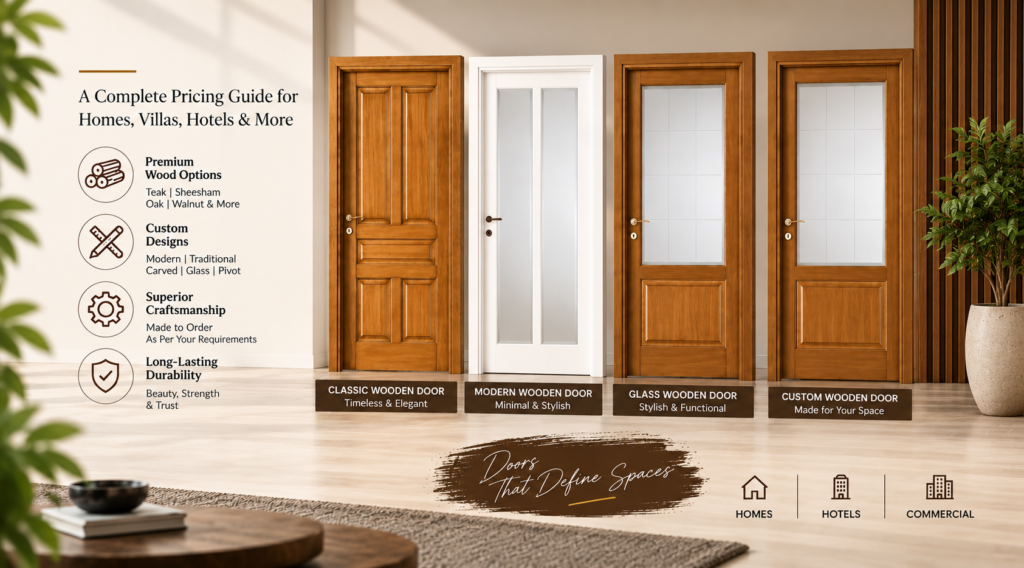
How to Optimize Your Custom Door Budget Without Sacrificing Quality
Controlling costs on residential or commercial projects does not require compromising on design or performance. Architects and property owners can balance budgets using these practical strategies:
- Adopt a Hybrid Material Strategy: Use top-grade solid teak or carved statement wood for the primary entrance, while utilizing high-grade natural timber veneers on engineered cores for interior bedrooms and washrooms.
- Standardize Door Sizes Across the Property: While height customization is straightforward, keeping interior door widths consistent (e.g., all bedroom doors at 7 × 3 ft) reduces material wastage and speeds up CNC fabrication runs.
- Choose Contemporary Linear Patterns: Minimalist horizontal or vertical V-grooves and fluted profiles require less machine run-time and labor than elaborate traditional moldings, lowering production fees.
- Source Directly from Established Manufacturing Hubs: Sourcing directly from regional manufacturers (such as custom woodworking units in Jodhpur, Rajasthan) eliminates multi-tier distributor markups, ensures proper kiln seasoning, and provides direct access to architectural CAD customization.
What to Verify Before Placing an Order: The Buyer’s Checklist
Before transferring an advance payment to a custom door manufacturer, verify these critical specifications in writing:
- Timber Species & Origin: Confirm the exact wood species (e.g., African Teak vs. CP Teak vs. Burma Teak) rather than a vague quote for “teak wood.”
- Kiln Seasoning & Moisture Content: Ensure the timber is kiln-dried to a moisture content between 8% and 12% to prevent swelling, warping, and shrinkage during seasonal transitions.
- Anti-Termite Treatment: Confirm that pressure chemical impregnation or boron-based anti-borer/termite treatments have been completed.
- Finished Thickness: Clarify the net thickness after four-side planing and sanding (e.g., ensuring a 35 mm door does not finish at 30 mm).
- Inclusions and Exclusions: Verify whether the formal quotation includes the door frame, multi-coat finish, glass panels, ironmongery cutouts, or site installation.
- Packaging Standards: For long-distance transport, verify that the doors will be dispatched with corner protectors, bubble wraps, and wooden crates.
Frequently Asked Questions
What is the average cost of a custom wooden door in India?
The cost varies based on materials. High-grade interior veneer doors average ₹5,500 to ₹16,000, solid hardwood interior doors cost between ₹12,000 and ₹35,000, and luxury solid teak main entrance doors range from ₹30,000 to ₹1,00,000+.
Why is teak wood more expensive than other woods for doors?
Teak possesses high tensile strength, natural wood oils, and tightly packed grains that resist rot, pests, and moisture damage. Its workability, long service life, and high market demand make it a premium timber across India.
How much does an oversized luxury pivot door cost?
An oversized pivot door (such as 8×4 ft or 9×5 ft) made from solid wood or metal-reinforced framing typically ranges from ₹1,00,000 to ₹2,50,000+. This price includes heavy timber volume, specialized internal stabilization bars to prevent bowing, and heavy-duty concealed hydraulic floor springs.
Can natural solid wood doors be used for bathrooms?
Solid wood doors can be used for bathrooms if they are thoroughly kiln-dried and sealed with waterproof polyurethane (PU) or marine-grade sealants on all six sides, including top and bottom edges. Many interior designers opt for calibrated flush doors with moisture-resistant laminate or veneer on the bathroom side to prevent warping.
How do I get an accurate quotation for a custom door project?
To obtain a firm quote, supply the wooden door manufacturer with: exact structural opening dimensions, preferred timber species, shutter thickness, reference sketches or architectural CAD elevations, choice of surface finish (matte, gloss, PU), and whether matching wooden door frames and hardware are required.


 Single Main Doors
 Double Main Doors
 Glass Main Doors
 Bedroom Doors
 Bathroom Doors
 Teak Wood Doors
 Oak Wood Doors



 Custom Door Finishes