Blog
Designer Wooden Doors: The Ultimate 2026 Guide to Architectural Masterpieces

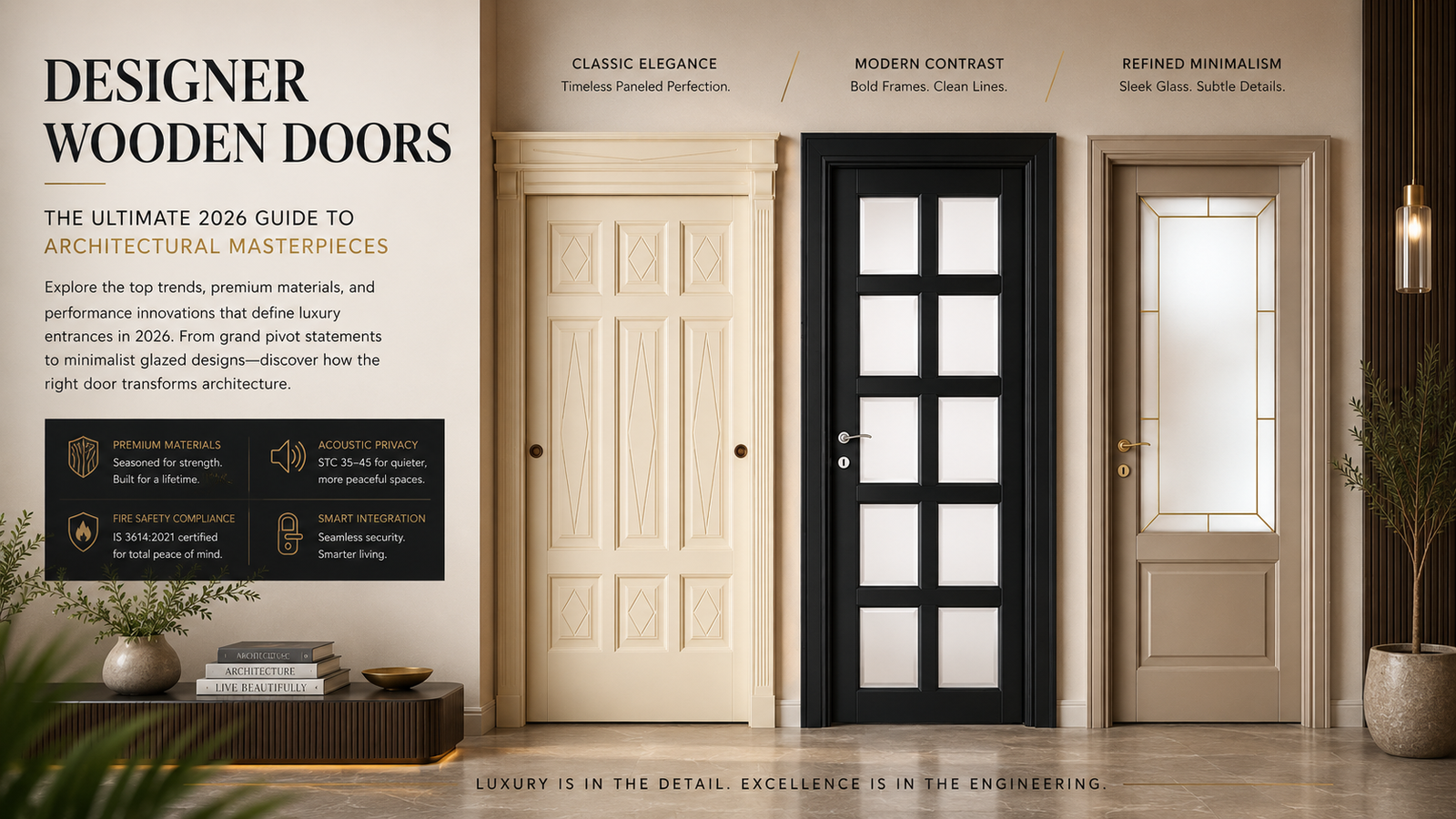
Designer Wooden Doors: The Ultimate 2026 Guide to Architectural Masterpieces
In the world of high-end architecture, a door is no longer just a functional partition; it is a profound intentional statement of scale, material, and movement. For 2026, designer wooden doors have undergone a radical shift away from mere ornamentation toward “material honesty,” where the natural grain, structural integrity, and invisible technology take center stage.
Whether you are designing a sprawling heritage villa in Jaipur, a sea-facing penthouse in Mumbai, or a boutique resort in the Himalayas, the right door anchors the entire architectural narrative. Substandard entryways can diminish the perceived value of a multi-crore project. To ensure your property stands out, understanding the latest innovations in designer wooden doors is your most vital procurement step.
In this exhaustive 1600-word guide, we break down the elite 2026 trends, the technical performance benchmarks (including the new IS 3614:2021 standards), and why choosing a factory-seasoned partner is the only way to secure your architectural vision.
The 2026 Designer Blueprint: Top Architectural Trends
Modern luxury in 2026 is defined by clean geometry, massive scale, and tactile restraint. Taller proportions (ranging from 8 to 11 feet) have become the standard, creating an “architectural” feel that expands the verticality of a space.
1. Grand Pivot Entrances: The “Moving Wall” Effect
The pivot door remains the pinnacle of designer wooden doors. By rotating on a central or offset axis rather than side hinges, these doors can reach widths of up to 6 feet—scales that traditional hinged doors simply cannot support.
- The 2026 Twist: Look for “Seamless Transitions” where the pivot door is clad in the same wood paneling as the adjacent walls, making the entrance virtually invisible when closed.
- Design Note: Use a single, full-height vertical pull handle in matte black or champagne gold to emphasize the massive vertical scale of the entrance.
2. Mixed Materiality: Metal-Wood Hybrid Inlays
The “2026 Modern Look” is defined by high-contrast textures. We are seeing a massive surge in solid wood faces (such as Teak or Walnut) interrupted by slim, recessed strips of brushed brass, graphite, or gunmetal.
- The Effect: These metallic lines catch the ambient light and add a futuristic, jewelry-like edge to the organic warmth of the wood grain. This is a hallmark of elite designer wooden doors for 2026.
3. Warm Minimalism & Concealed Frames
For high-end interiors, the trend is toward concealed or “invisible” frames. These doors sit perfectly flush with the wall, using 3D-adjustable hidden hinges to disappear into the room’s design.
- Color Palette: Deep, saturated matte tones like charcoal, warm beige, and “Quiet Luxury” walnut grains are replacing the high-gloss finishes of the past.
Choosing the Right Material: The Foundation of Luxury
Material choice dictates not just the look, but the decade-long lifespan of your designer wooden doors in India’s varied and extreme climate.
| Material Type | Best Use Case | Key 2026 Performance Feature |
| Premium Burma Teak | Grand Main Entrances | Naturally termite-proof; zero warping in Rajasthan heat. |
| American Walnut | Interior “Statement” Doors | Deep chocolate grains; perfect for minimalist matte finishes. |
| Engineered Wood | Coastal / High-Humidity | Resists swelling in Mumbai/Goa monsoons; 100% stable. |
| White Ash & Oak | Japandi / Zen Interiors | Light, airy textures; ideal for satin-touch minimalist designs. |
The “Invisible” Quality: Industrial Seasoning
The biggest mistake in door procurement is ignoring moisture content. Reliable manufacturers of designer wooden doors utilize industrial kiln-drying to reduce moisture to an exact 8-12%. In the dry air of Jaipur or the humidity of Mumbai, unseasoned wood will inevitably crack or jam. Always verify that your designer wooden doors are factory-seasoned to ensure they remain a permanent asset.
Technical Performance: The “Performance Door” Revolution
A designer wooden door in 2026 must perform as well as it looks. Architects are no longer ticking boxes; they are specifying “Integrated Life-Safety Systems.”
1. Acoustic Privacy (STC 35-45 Ratings)
In a world of constant digital noise, silence is the ultimate luxury. For home theaters, master suites, and corporate boardrooms, specify designer wooden doors with an STC (Sound Transmission Class) of 35 to 45.
- How it works: These doors utilize specialized acoustic cores (like tubular chipboard) and automatic drop-down seals that deploy when the door closes, creating a vacuum-like seal against hallway noise.
2. Fire Safety Compliance: The New IS 3614:2021
Modern building codes (NBC 2025 Part 4) have tightened. Designer wooden doors can no longer be “mix-and-match” components.
- The Requirement: Every fire door must be a Tested System Assembly. This means the door leaf, frame, hardware, and intumescent seals must be tested together as one certified unit.
- Rating: Specify 60 or 120-minute fire ratings to ensure your luxury project is both beautiful and legally compliant with the latest BIS Quality Control Orders.
3. Integrated Smart Automation
The “Smart Home” of 2026 demands “Ambient Intelligence.” Top-tier designer wooden doors now feature:
- Concealed Biometrics: Fingerprint sensors built directly into the underside of a custom pull handle.
- Matter-over-Thread Standards: Ensuring your door lock synchronizes seamlessly with your home’s lighting, climate, and security ecosystems.
- Discreet Power Transfer: Hidden wiring through the hinges to power electronic locks without visible cables.
Sourcing Strategies for Architects and Builders
If you are a professional in the field, your relationship with a manufacturer of designer wooden doors is a strategic asset.
Consistency in Large-Scale Hospitality
For a 500-room luxury hotel, “Standard” is not enough. You need Designer Wooden Doors that maintain identical grain patterns, polish tones, and alignment across every single unit. Factory-finished doors are no longer a luxury; they are a necessity for 2026. Every door should arrive “Plug-and-Play,” pre-machined and pre-finished to avoid on-site dust and damage.
Secure Nationwide Logistics
Transporting a 150kg solid wood pivot door requires industrial-grade handling. Expert manufacturers use foam-padded crating and dedicated transport to ensure your masterpiece reaches the construction site in flawless condition, whether it’s in the heart of Delhi or a remote hill station.
(For technical guidance on timber grading and NBC Part 4 compliance, you can consult the archives at the Forest Research Institute of India.)
Conclusion: Partner with Excellence
Choosing designer wooden doors is an investment in your property’s value and your daily experience of luxury. These doors are the “gatekeepers” of your private sanctuary. By selecting a partner that understands the science of the Rajasthan desert seasoning and the precision of modern engineering, you are securing a legacy.
Do not settle for “good enough.” Choose the brand that treats a door as a masterpiece of both engineering and art.
Ready to design your next architectural statement?
Contact Boon Doors today—the authority in high-performance designer wooden doors. Let’s evaluate your blueprints, assess your acoustic STC needs, and provide an elite B2B quote for your 2026 project!
Frequently Asked Questions (FAQs)
What defines the latest trends in designer wooden doors for 2026?
The 2026 trends are defined by Minimalism, Large-Scale Pivot Entrances, and Mixed-Materiality. We are seeing a move away from glassy shines toward matte and satin finishes with subtle metallic inlays in brass or gunmetal.
Are designer wooden doors durable enough for India’s extreme climate?
Yes, provided they are industrially seasoned. Designer wooden doors from reputable manufacturers are kiln-dried to 8-12% moisture content, making them resistant to warping in the dry heat of Rajasthan or the humidity of coastal regions.
How do I ensure my luxury door is soundproof?
Look for doors with a certified STC (Sound Transmission Class) rating of 35 or higher. These designer wooden doors include high-density cores and perimeter gaskets that effectively block out traffic and corridor noise.
Can designer wooden doors be fire-rated?
Absolutely. Under the new IS 3614:2021 standards, luxury wooden doors can be engineered to provide 60 to 120 minutes of fire resistance. These are tested as full assemblies (leaf + frame + hardware) to ensure maximum life safety.
Which wood species is best for a modern designer door?
For a dark, sophisticated look, American Walnut is the top choice. For a timeless, durable heritage look, Burma Teak remains the gold standard. For light, “Zen” interiors, specify White Ash or European Oak.


 Single Main Doors
 Double Main Doors
 Glass Main Doors
 Bedroom Doors
 Bathroom Doors
 Teak Wood Doors
 Oak Wood Doors



 Custom Door Finishes